Saturday, 21 July 2012

Pressure Rising

The blooming

Mumbai sizzled on the edge of monsoon. The sea wall along the waterfront a solid line of the young and old, men, women and children sitting, watching, waiting and catching the breeze. Turgid water lunged at the rocks, spray rose, people squealed, saris fluttered and then a few drops of rain and the wall suddenly blossomed, umbrellas snapped open, catching the light and fluoresced. Umbrellas in India? Any shade you desire. Couples huddled under plastic, umbrellas, jackets – no longer clandestine – love is in the open! Overnight the city became green, lush, damp and steaming. I find new energy in this weather change. Barometer rises, barometer falls along with the blood!

Haji Ali Mosque Mumbai
Ahmedabad a few days later suffocated the lungs. Caught as it is in its own desert climate, intensified by concrete and relentless sun. I ran helter skelter for my life dodging traffic and seeking shade where I could. Clouds did not gather only gloom. On the day I left for Bhuj a few drops reluctantly fell, squeezed from a sudden passing bank of clouds like blood from a stone. The drive was forlorn. A pair of wild ass far from their sanctuary wandered in search of fodder – risking death on this truck-laden highway. I made up some lines:

‘On the seventh mile of highway, my driver said to me, nine toppled trucks, eight dead dogs, seven autos racing, six horns abeeping, five goats ableating, four sweeping nuns, three  camel carts, two wild ass and a peahen in a neem tree!’

The silliness kept me occupied for a while and I did get to the twelfth mile. At Bachau I swapped cars and drivers. Umar was waiting and the exchange ensures a safe return for both drivers. I always feel at home in his presence, slip easily into this ten year relationship and quickly catch up on the gossip as we drive into the dusk. More factories and more slums line the entry into Bhuj and now Umar tells me development is good. He has changed his tune and I reprimand him. He who has sat with me during discussions with those whose livelihoods are threatened by the industrial juggernauts! But it's all a matter of checks and balances in the heavily weighted game of development! Pockets bulge in some quarters while others suffer as traditional grazing lands disappear, Chinese imports undercut the work of artisans, coal fired power stations destroy coastlines and fishing and villages get swallowed into new towns. He of course has plenty of business.

Kachchh in this July month simply shrivelled, seared by the sun and parched from lack of rain and coated in dust. The omnipresent dust of eons. Thousands of plastic bags caught in trees along the roadsides do nothing to enhance the view. They fluoresce ominously in the setting sun - unlike the umbrellas of a few days back. In Bhuj I was the only guest at the Hotel Prince – now officially closed (shades of being the only guest in the Gangaram soon after the earthquake!). I enjoyed the solitude of my usual room, 220, on the second floor although the corridor is now windowless and I put a towel along the bottom of the door to keep the dust at bay. The whole place is stripped out. A large foreman seemed to spend most of his time horizontal in the rubble as his lethargic workforce moved from one task to another without quite finishing anything. Young men plastered, painted and sanded amidst the usual tangles of electrical wiring. The lift worked (it still sang to me between all two floors), the telephone did not! The downstairs restaurant remained open to the public and a greatly reduced staff served thali three times a day. The owner’s son assures me they will be open by October and I am only thankful that I do not have a tour booked for then!

The golden moment in this flying visit was the late surfeit of mangos – organic, frozen, fresh, whole, juiced or pulped they sustained me until Mumbai and rain a few days later. I do not like flying visits such as this one, I neglect friendships although I did accomplish my mission albeit with dogged determination and sheer bloodymindedness. ‘Only crazy girls come to Kachchh in July’ I sent the text to Andrea from San Francisco also in Bhuj on her own dedicated mission. She agreed and we met for a quick meal in memory of Ranju. But more of missions next time, local wisdom and the beginnings of a story of a mansion in Mumbai.

I do note that I’ve been away and off the air for some time now. Me the blogger who promised herself that she would feed the words every week! Bear with me!

Monday, 7 May 2012

Regrouping - the new journey begins


I can’t begin to recount where the past five weeks have gone since I walked in the door from India and began the real work. They certainly disappeared down the chute of time so rapidly that I woke up one morning to the realisation that Markers for the Journey had opened the previous night. I was still wired – I mean how can the energy required to mount a major exhibition suddenly turn off? How can the unleashed creativity be abruptly reigned in and how can one face the space that held me captive while I cut, stitched, placed, sorted, pressed, printed and let my ideas run riot? I opened that door today and shut it again promptly. The clean up will wait for another time.  Instead I open up my computer and clean up the desktop – this activity takes less brainpower and certainly requires less physical energy although I do get caught up in images let loose on the screen. I sit absorbed into the memories of camels at sunset in the wide flat landscape near Chari Dhandh wetlands, the small giggling girls from Hodko carrying their water pots bright and new from the wedding the previous night and the seamed face of Ayub, camel trader from far away, as he wrote his name and number in my journal with such pride in his ability.

Girls with shiny new water pots the night after a wedding at Hodko.           © Carole Douglas 20912


If I were honest I’d say I was tired but I am afraid to give in because it is ten years since I accepted the invitation to exhibit at the Manly Art Gallery and Museum and now that I have done it I simply want to keep following the inspirations that were waiting for me in boxes – out of sight and out of mind and now in full vision and full frontal lobe! And it is much more than ten years since I exhibited my own work – funny how an earthquake changed my direction and lead me on a circuitous route to this.

Markers for the Journey is a reflection on my first15 years in Kachchh, a journey that is echoed in the narrative imagery of those who journey in the landscape of that most magnetic of places and it is a tribute to the people who have enriched my life in so many ways. And if you are in Kachchh and reading this then you know you are one of them! Thank you.

Kuldip Gadhvi and Sumar's brother share a yarn over early morning chai. © Carole Douglas 2011.           


I use three large screens onto which we project glimpses of the lives of wandering pastoral people – Maldhari, Fakirani Jats  and Rabari. While I know that in reality the divisions are not quite that cut and dried I use them as a framework from which to hang the details – the shelters, textiles, adornment, land use and ritual, and to uncover the patterns of life and the complex codes of tradition. The fourth screen, a 2m diameter circle of salt crystals on the gallery floor, carries circular symbols of heritage, beliefs and local iconography. The soundscape that accompanies the imagery was recorded over an extended period of time. It carries the ambient sounds of Kachchh and gives voice to the people and their animals who wander this resilient land. 

3 large screens and a circle of salt on the floor show images that reflect the wandering life. © Carole Douglas 2012
 The gallery space is divided (and thus darkened) by a ‘wall’ of floor to ceiling black woollen shawls found just in time (March) in Bharat’s shop in Bhuj. Brand new, 3.8 m in length and subtly tie dyed they are the answer to this artist’s prayers. On the wall facing the screens is a 3m length of heavy wooden dowel over which is draped the everyday textile items of pastoral communities – shawls, quilts, jackets, skirts, scarves – oudni, kanjiris, dadkis, choliyas – made not by any NGO or craft cooperative but by the people themselves. And like the people these items are honest, strong and enduring. 

Items of the everyday kind. Original pieces from Kachchh. © Carole Douglas 2012


Just two weeks before we set up the gallery, Mike and I went scavenging for branches to interpret the ‘markers’ pastoral communities place along roadsides to indicate a nearby camp. We looked far and wide and then found exactly what we needed close to home in the yard of the local ambulance station. They had cut down a mature gum tree – perfect branches, straight enough and forked in just the right places to hold the needs for journey – cloth covered water bottles, animal bells, bags and other necessary items. We finished off this darkened space with randomly placed round mirrors to catch the light in much the same way as a mud mirror wall or an embroidered bodice glints seductively and elusively. I now sit in this space – a piece of Kachchh within the walls of Manly Art Gallery and Museum - and watch the still and moving images as they morph one into another – a mirror becomes the sun becomes a shepherd’s eye … and I am ‘home’ again. And on the other side of this intimate space is another story for next time. 

Random mirrors and a 'marker' for the journey. © Carole Douglas 2012


Markers for the Journey is on at the Manly Art Gallery and Museum in Sydney until June 3rd so if you are in the vicinity do drop in and become part of the magic of Kachchh. If not, then I will bring it to you – Inshallah.


Friday, 23 March 2012

Small Worlds


Surprising who you meet in unexpected places. Today I went shopping for fabric - of the kind worn by the shepherding communities of Kachchh – in particular the northern Banni/Pacham area. You may well wonder why I shop for such an unusual item here on the Northern Beaches of Sydney - a world or three away from the land of sheep, goats, camels, cows and buffalo. Indeed, all I saw today of animals on the busy roads leading to Belrose were recent road-kills – several possums and a wallaby. Not a loping camel in sight – but here's the real story. 

Camels on the Banni © Carole Douglas 2012
I am making a Toran (at least my interpretation) to welcome visitors into my exhibition space at Manly Art Gallery next month. Each ‘leaf’ is a tribute to certain people, communities and events that have ‘marked’ my own journey. Of great personal significance are the shepherds, the wanderers who criss-cross the rugged landscape with their herds. I spent one of my most memorable moments drinking chai with camel herders in 1995 during an early foray into remote areas. The camel milk brew was rich and satisfying and my hosts curious and hospitable. I have not since lost my fascination for this land and those who are so deeply connected to its essence.

Fakirani Jat shepherd boys at Chari Dhandh © Carole Douglas 2012
So when it came to the ‘leaf’ representing the various herding groups – Sumara, Raysepotra, Halepotra, Jat and others - I needed colours. Kuldip, bless him, sent me the six I requested and when I finally resolved the design, I knew I needed to complete the palette! By some quirk of fate, the self same poly-cotton from India is carried locally and it was not hard to source the various shades of red, purple, green, blue, grey and brown. I had a bag of scraps collected a few years back from a tailor’s floor in Khavda (the last service town before the Great Rann of Kachchh and the Pakistan border) and I carefully matched each colour. I apologised to the salesgirl for the effort required to carry and cut from several rolls of fabric when I only required a sliver of each. The young woman who so patiently served me had observed me matching the small remnants and asked what I was making. 

Khavda, the 'wild west' of Kachchh © Carole Douglas 2006
Men of Colour at Rann festival © Carole Douglas 2004


She, it turns out, is from Punjab and had done her masters in textiles and her thesis on Jute. We began a deep discussion on textiles until it was abruptly cut by the sharp look of an older salesperson. We exchanged email ids and I will contact Shuki. She believes there is no application for her knowledge; I believe there is. India, Spotlight and shepherds. It's a small world.

Then I went to Bunnings Warehouse to choose the paint sample for the words that will spell out on the gallery wall, the names of many herders and their wives and children met along the way. In the dimly lit cavernous space and with my glasses in the car, I picked out a couple of paint chips that seemed to be the right shades and drove home. The names revealed on the chips? Camel Cord and Buffalo Brown. I could not have chosen better with my specs on! Small world interconnected at the very core! 


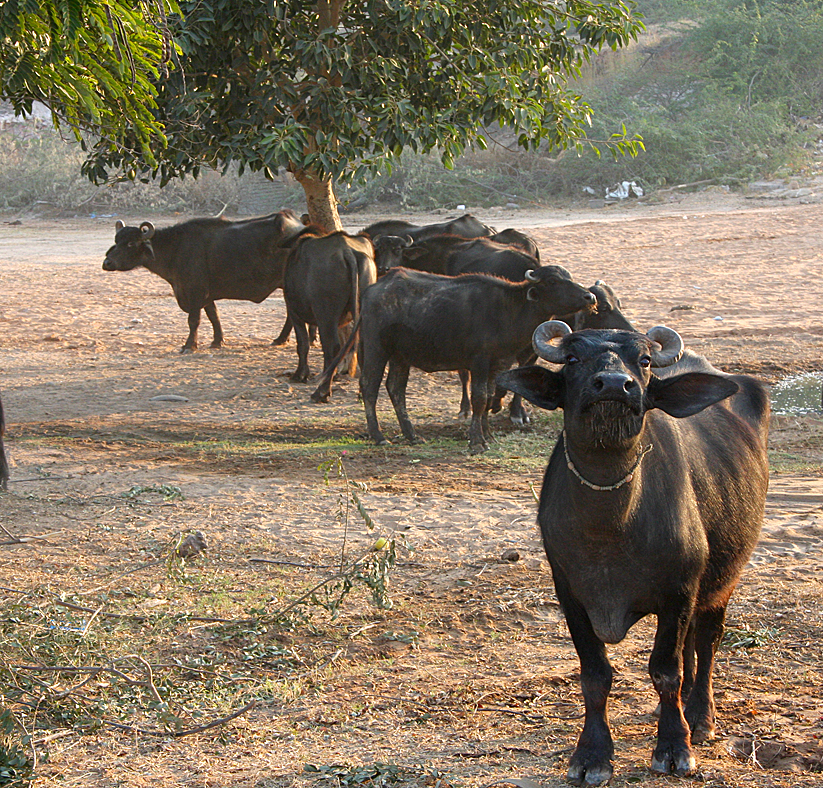
Buffalo. Not Northern Beaches but Nhakatrana © Carole Douglas 2009

Tuesday, 6 March 2012

Tourist not Terrorist


The last time I used this phrase was in 2002 when the Indian-Pakistan border was flaring again and Stealth bombers vied with the local crows for dominance of the bleached skies over Kachchh. I was woken at 2 am by heavy banging on the door of my room at the Lakeview Hotel – a seedy establishment opposite Harmisar Lake which belies its name. The lake is merely a pond fed by the sky and, depending on the latest monsoon, varies from being a fetid muddy puddle to a vast, overflowing water body. The intruders were the police checking up on itinerants and I was only concerned that they would find my bottle of whisky stashed under a pile of clothes in the closet. After checking my papers - which they could not read - and casting their eyes over my room (and semi clothed body) they departed. They did not comprehend my early morning play on words and they did not find the bottle!

A few days back - although the way I keep dropping in and out of shifting time zones it is rapidly disappearing into weeks - I was summonsed from the Lufthansa Lounge where I was calmly recovering my mislaid wits and ordered to follow a young man into the nether reaches of Mumbai’s unpronouncable International airport. It was a long journey downwards in creaking lifts and across vast spaces filled with baggage handling equipment, scanning devices and luggage of all shapes and sizes. It was hot, airless and fume laden. And I was tired. The offending items were in my small overnight bag and I was instructed to locate and remove them while the authorities stood behind a metal partition. I duly removed all the plugs, cables, adaptors and camera bits and pieces. I had not removed the rechargeable batteries from the charger and I had not wound and tied the leads and cables in an orderly fashion. They showed me the x-rayed jumble on the screen and I have to admit it did not look good.  After a lecture on keeping my accessories in neatly wound bundles I was escorted back to the lounge by the young man, who managed a smile at my old joke, just in time to gather my carry on bags and catch the flight home. I have not yet recovered my wits or my mislaid property. I did have Laksmi in my wallet so I hope she will find her way back to me along with the contents of said item intact. Mumbai is a city of the ‘great distraction’ and taxis seem to have a way of disengaging the mind while swallowing loose stuff. No blame.

More than a month has passed since my last posting. A month of dust, mud and cold winds (it snowed in Kashmir hence Kachchh was icy);  a month of hot breathed camels, high stepping goats and steaming buffalo; a month of sitting in circles  drinking scalding smoky chai made from various milks and a month of recording the sounds and images of those who wander the land in charge of flocks and herds – the Jats, Sumara, Maldhari, Rabari and shepherds of many remote communities. The call of morning birdsong is a miracle of the wakening world; the shrill cries of camel herders a ululation in the wild; the passing of goats in the dust a chattering cacophony of hoofs, bells, clicks and bleats. I recorded the makings of a symphony of the land and the challenge to turn it into the music it deserves to be lies ahead.

Bleating cacophony of sheep goats and shepherd. Lakhpat area. © Carole Douglas 2012
Pattern of movement. Dhebireya Rabari group (Kachchh) heading  for Saurashtra. © Carole Douglas 2009


I now move into the production phase of editing and shaping the impressions of a wandering life via four projection surfaces including salt, several speakers and an installation of ‘markers’ to map territory and identify place in the ‘jungli’ - local term for wilderness and wildness.  I hope you will join me, in heart if not in body, at the opening of 'Markers for the Journey' on April 27th  6pm, at Manly Art Gallery and Museum, Sydney.

Wednesday, 1 February 2012

The Colours of Life


Field near Bagru, Rajasthan 2011
Colours speak
they shout they sing for
themselves
and for all who
care to see.
Colour my days, Bagru 2011
Fifty thousand images in my iphoto library and still counting, still sorting, naming, categorising, filing and then I surrender to the uncertainty principle. Does the image go under India, landscape, mood, person, date, event or ??? Today I sorted new images into colours because there was Rajasthan sizzling in the line up, the line down, the line across – leaping off the screen in bursts of the hottest pink, the most fiery of red, most incandescent orange – sitting under a lone tree in a monochromatic landscape (left), gossiping in alley ways (below) and leaping off the vegetable vendor’s cart in a shower of marigolds (below).


Somewhere between Bagru and Udaipur, 2011
Then bored I leave the images to sort it out for themselves and begin to unpack, unfold and undo shelves and boxes of textiles in my would-be (if I had time) studio. Years of collecting for the rainy day confront me - the rainy day that arrived sometime last year, turned into weeks and may last into months or even seven years as I am told by Elizabeth who says she has heard that it’s an aboriginal prediction.

 Anyway,  prediction, climate change, el nino whatever - the big wet has rendered all that I own damp to the touch and impregnated with mustiness - a smell I attach to my grandmother’s blanket box closed to the air after she went electric. I also itch. Sometime between Mallorca and Manly I developed an allergy triggered by things I love – our couch that malingered in storage for five years, a denim jacket washed several times and stil refuses to surrender its spores, my raincoat rarely worn and now in daily use, cushions, jeans, old clothes (just in case I get slim again), barely used beach towels - all set me off – and most tragic of all the beloved textiles are the worst. Shawls, rugs, quilts, embroideries – the accumulation of a lifetime’s affair with colour, texture, pattern - set my skin on fire. Today, it does not quite rain and I must liberate as many as I can into the fresh air, or wash, dry or even discard if I dare to or can bear to. Or simply take another antihistamine!

Western mastery /mistressy - Beth wins! Hodko 2011
And speaking of odours - the parcel finally arrived containing the pieces ordered by my last tour group who fell in love with the Kambira stitches of Hodko, learned how to create them and had to own a piece or two. The green stepped running stitch on two shades of red and black on two shades of yellow were too much to resist. I unpicked the stitching (I kept the calico for another rainy day), untied the blue plastic bag and released the pieces. Colour spilled out along with the scent of the Banni, of pastoral wanderings and moonlit buffalo milking. Airing may diminish ( if one wants to) this endearing scent that lingers somewhere between the solid nose of fresh buffalo milk, the earthy tones of dried dung, the woody fragrance of cooking fires with a strong base note of human endeavour! One might dream of mud-mirrored, earth-floored, thatch-roofed Bhungas while sleeping under such a quilt even if one had never been there!

A rare moment of silent concentration - calm before chaos! Sumar Kaka's home, Hodko 2011
 I’ll be there in person next week. I itch for India but I do not itch in India even in the sog of monsoon - Indian spores seem to agree with me. I’ll pick up the rest of the Kambira pieces and watch out for flashes of Kachchh colour in the landscape – hues not at all Rajasthani. Regional differences! And for those of you who know him, I’ll be dancing at Kuldip’s most colourful wedding and very happy to carry your greetings. Next blog after that then! Watch this space.

Tuesday, 10 January 2012

A Community by any Other Name

I missed the first screening of Kevin McLeod picking his way through Dharavi - the community thrust into the limelight by ‘Slumdog Millionaire’. I did not see it because I was in India at the time and if local reactions were anything to go by I had no desire to chase it down. However curiosity eventually got the upper hand and I recently watched the rerun of both episodes. The movie irked me enough but not nearly as much as this story which from the outset seemed obsessed by 'shit' - the most emphasised (and perhaps the most repeated) word in the program. I have visited Daharavi several times over the past few years, initially because I have an interest in waste management and then to meet the ‘kumbars’ from Gujarat – the potters who continue their village traditions in the midst of the megalopolis. Besides, I'll  take any opportunity to improve my less than average Gujarati.

When I first visited Dharavi it was in the company of one of the partners of Reality Tours in Colaba. Krishna led me into the community, not over precarious pipes, waterways clogged with sewage and tracts of waste but off a main street where we squeezed through narrow residential laneways and into the recycling zone. Nor was I confronted with children openly defecating. I am sure they do, just as I know there are tracts of putrescent waste and raw sewage at Dharavi’s edges but I have little recollection of its stench. I do recall acrid industrial fumes and the smell of freshly baked goods and most of all I recall neatly uniformed children streaming out of small dwellings and setting off for school; of drinking chai in a tiny, spick and span room with no space to spare and of discovering the myriad ways in which the metropolis’ waste is reused and recycled. My last visit was a few months back when I went alone to visit textile workers - no hassles encountered.

The spread of the horizontal between the vertical. Flying into Mumbai.
The tour groups I take into Mumbai are offered the option to visit Dharavi with the Reality team who use profits to support literacy and vocational training programs. To date no tour member has turned down the opportunity and on a certain level it is gratifying to witness western preconceptions blown away by something as consciousness-changing as Dharavi. Of course I have concerns - I am under no delusions about the realities of the place - the sheer population density, unregulated industrial practices and lack of all the amenities we take for granted are daunting. Yet by the end of his stay McLeod had also shifted his focus as he moved from an intimate encounter with a local family to discovering thriving commercial enterprises and along the way sensing the deeper connectedness that makes for community. And his real concerns about imminent human displacement on a grand scale are shared by many. It is a strange notion that wants to force the vertical dimension onto those who live on the horizontal plane. You can’t force a flat peg into a tall hole as western society knows only too well. Rural India has always infiltrated its cities at ground level, fitting in where it can between high-rise buildings, spreading along river banks, filtering into green zones and creating community as its inherent right. 


All traces remain of a recently thriving community. Sarbamati River near Ellis Bridge. Nov 2010.
I recently witnessed the razing of a large riverbank settlement in Ahmedabad. In a sweeping gesture to beautify the Sarbamati river, which incidentally it is not - the water is diverted from the Narmada river, the government of Gujarat rolled in with bulldozers. In their wake lay a graveyard of broken homes and shattered lives - the underbelly of a city was scraped away in a few short hours. 

Servicing the wider community on Sarbamati Riverbank.


Local industry on Sarbamati Riverbank
Local community on Sarbamati Riverbank
Gone now are the rope makers, dhobi wallahs, dyers, embroiders and menders of anything including my shoes. Gone too are the goats and chickens, festivals, religious occasions, music and the constant whisps of blue smoke from cooking fires. They are no more. Instead we will have a clear view of high concrete walls designed to withstand the least likely flood levels, a busy parallel road, a dusty expanse of earth embedded with the remains of a community and the lure of luxury living in waterfront developments. I hear that the displaced are to be housed in high-rise dwellings far removed from the banks that sustained them. 

Children of the riverbank.

Riverbank dream - a nightmare for some. New billboard Ahmedabad 2011.
In the meantime Dharavi, by all accounts, is well and truly discovered. Leading Indian designers recently held an innovative workshop in the community and a new design paradigm is in the making. In his blog (see http://ishankhosla.wordpress.com/author/ishankhosla/), Delhi based designer Ishan Koshla refers to a ‘new language’ of patterning and that led me straight to my bookshelf and to a well thumbed tome.

‘We begin with that part of language which defines a town or community. These patterns can never be ‘designed’ or built in one fell swoop – but patient piecemeal growth, designed in such a way that every individual act is always helping to create or generate these larger global patterns, will slowly and surely, over the years, make a community that has these global patterns in it.’
From A Pattern Language by Christopher Alexander et al.

So saying - may the one and the many deities that dwell in the heart of Dharavi bless the place and the people who create it’s patterns of community – piecemeal, by design or by necessity. I have no bigger solution.

All images © Carole Douglas - taken between 1998 and 2011.

Saturday, 31 December 2011

In the Zone


That’s where I was told I was while in my local bank last week when the computer system was down and pre Christmas nerves were frayed. Agitation all around so I told the waiting queue about my recent tour group’s experience at the GPO in New Delhi just a couple of weeks ago. ‘This wait is nothing’ I began ‘you should try sending a parcel from a certain post office in India”. And so I launched into the story about how one of Australia’s leading embroiderer’s stitching efforts were rejected by the only stitching man on the job that day. It took four hours for six women to send parcels home and after Jane’s immaculate attempt we were not allowed to stitch our own - even after said parcel man’s efforts were also rejected by the weighing man and that came before franking and stamping and final dispatch. ‘Wow’ said the young woman balanced on 10cm heels in the Manly branch of the ANZ ‘you must still be in the zone’. And I am – nothing much can phase me here in the easy haven of Sydney after a few weeks on the subcontinent where twelve women and I travelled from Kachchh to Kolkata by bus, train and plane with auto and cycle rickshaws and the odd camel cart journey thrown in for good measure.

Boarding the flight to Bhuj - luggage came next day!
The last leg of the tour - Khanpur station 80k from Lucknow
and a long night away from Kolkata.

This group of dedicated embroiderers (bar one) stitched their various ways across India – from bold Kambira stitch in a mud hut in the Banni (Kachchh) where the teachers were shrill voiced artisans hell bent on selling their wares which came out from under their skirts as soon as the momentum slowed - to the beautiful running stitch of Kantha  (Kolkata) in a small room surrounded by round, soft voiced Bengali women who plied us with sweet chai and biscuits and demanded nothing in return for their gift of sharing. Between those two delightful extremes came many occasions with other artisans keen to show and share – Rabari, Ahir, Mutwa, Megwhal, Samma, Jat, Sodha and the great skill of the chikankari artisans of Lucknow.

Banni Kambira workshop.
Graced by the presence of 87 year old Ahir artisan Parmaben Balasara
one of the original artisan members of Shrujan, Bhuj.
Alison Snepp, NSW, in her element with Chikankari in Lucknow.
Margaret Light, NSW, follows her Kantha muse in Kolkata.
Jane Nicolas, NSW, captures the lovely running stitch in Kolkata.

Not that the journey was smooth all the way. A flight acquired flu arrived from Sydney with a group member and insidiously worked its way through most of us for the whole month. This made travel even more challenging for all of us at different times. Airlines should include health warnings in their safety demonstrations.

‘Please do not board this aircraft if you show any of the following symptoms (list). Should you experience the slightest tickle or tingle, wheeze or sneeze please contact your nearest flight attendant and ask to be placed in isolation. If the person sitting next to or behind you begins to cough a helmet will automatically drop down over his or her head until the plane lands and all other passengers are safely off the aircraft. Any person caught or reported coughing without an approved mouth cover will be shown the nearest exit. This plane is fully air conditioned and any germs are guaranteed to reach all passengers by touch down.’ And so it goes – the joys of flying in ever more cramped conditions with the attendant lack of fresh air, leg room and a headset that delivers.

Why do we do it? I know that I do it because I love the challenges, the contrasts, the creativity, the dignity and the differences and the sameness of humanity in all its forms.  Coming home for me is always a bit of a crash landing – culture shock in reverse but more of that next time. In the meantime let’s all come through the festive season relatively unscathed and still in pocket. Enjoy family and friends and do not forget strangers. We are off to Hobart on Christmas morning on the first flight to share seafood with son Simon and to rest for a few days - and heaven help anyone who even clears their throat on the plane! 

In case I do not get to a computer beforehand I send you all New Years greetings. Let’s make 2012 a year of compassion, creativity and commitment to all people, other species and the planet that supports us. My only resolution? To stay in the zone!